Patient-first record review
Make psychiatric records answerable.
Structured AI-assisted review, framed by OuiDire's audit model.
Turn difficult records into source-linked cards, reviewable findings, visible patterns, and structured exports—without replacing human judgment.
Structured audit model
What does the OuiDire method add?
OuiDire's AI layer is useful because it is guided by an audit method and keeps its suggestions linked to the cards, citations, and source records.
Documentary audit lens
OuiDire knows how to read psychiatric records
OuiDire brings an informed, experience-based documentary reading method to the file: recycled narratives, missing context, unsupported claims, contradictions, and second-hand statements that harden into fact.
Guided AI review
AI suggestions stay inside a structured audit method
OuiDire uses Gemini models as one analytical layer, but the product is the workflow: source-linked cards, review macros, human decisions, and exportable findings.
Concrete method
Built from real records
OuiDire grew out of a need to equip patients and lawyers to read psychiatric records more critically. Its macro sets were shaped by files from Québec and New Brunswick, but are meant to grow with records from other regions and jurisdictions around the world.
Claude product review
What an AI-assisted product review noticed.
In a structured product review performed with Claude, OuiDire stood out less as a generic AI wrapper than as a structured audit cockpit for psychiatric records. These observations come from an AI review, not an independent human expert.
What I found instead was a methodology.
Claude · Product review
 Claude · Product review
See the full product review
OuiDire tries to increase the analyst's epistemic accountability.
Claude · Product review
It surfaces what you might have missed and asks you to decide.
Claude · Product review
Workflow
How OuiDire turns the record into verifiable points.
OuiDire first helps you get a usable thesis and analytical terrain from the record. Card-by-card review then helps you appropriate the file yourself and turn that terrain into human signal, metrics, visual maps, and exportable findings.
- 1 Upload a PDF or photographed pages
- 2 Run OCR to create the cards that anchor citations, metrics, and visual maps
- 3 Generate a strategic overview in seconds: thesis, narrative clusters, key tensions, and critical omissions
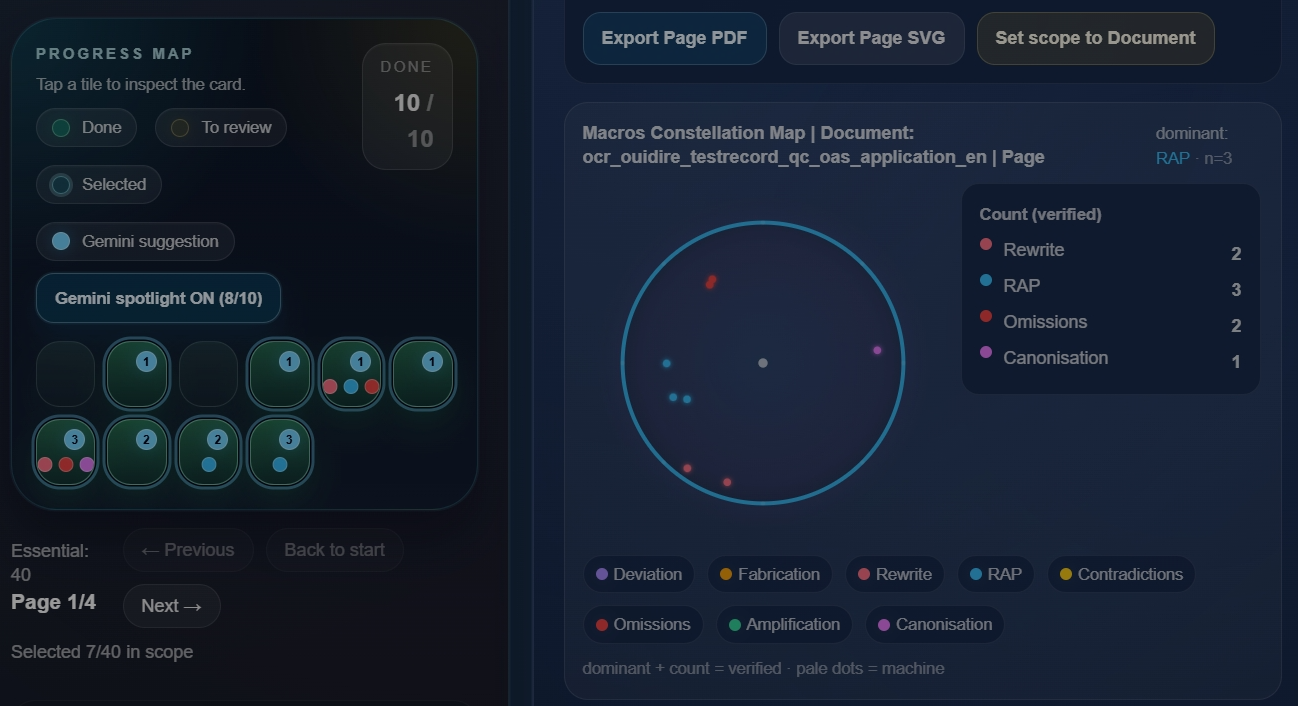
- 4 Use card-by-card review to study the record yourself and build stronger metrics and visuals
- 5 Run deeper analysis when needed with Gemini suggestions across one or both macro sets
- 6 Export the thesis, findings, citations, visual maps, and synthesis that matter
Quick Guide for the first workflow. How OuiDire Works for the deeper system view. Glossary for the vocabulary.
Access and pricing
Start with credits or discuss a firm package.
Public credit packs
Buy CAD 10, 30, or 60 in credits from the “Ready to start” area of the OuiDire workspace.
Limited guided trial
A guided trial may be offered on request with a demonstration record and defined usage quotas. It is not an open, unlimited self-service trial.
For firms
Firms use the same source-linked workflow and can contact Studiorium to discuss a package suited to their needs.
Practical answers
Before you begin.
- What can OuiDire export?
- The Gemini Digest can be exported as PDF, plain text, or JSON. Other structured outputs preserve the findings and source references selected in the workflow.
- Where are credits purchased?
- Open the OuiDire workspace and use its Credits section. Public packs are available for CAD 10, 30, or 60.
- What does a firm package cost?
- Firm packages are arranged on request. Contact Studiorium to discuss a package suited to the firm's needs.
- How is OuiDire different from a general-purpose LLM?
- OuiDire applies a defined audit method, keeps findings tied to pages and source cards, and separates AI suggestions from human decisions. It supports legal review but does not replace professional judgment.
Three core review layers
Orientation first. Verification after.
Strategic Overview · Gemini
The first analytical payoff
A Gemini-powered thesis, clusters, tensions, and omissions generated quickly from a capped sample of the record.
Card infrastructure
Verification, metrics, visuals
Cards anchor citations and let human review produce metrics, human review maps, and traceable visual terrain.
Human annotations
Validation and decisions
The reviewer confirms, rejects, annotates, and decides what deserves to be defended.
Learn more about the review layers
The Gemini-powered Overview is the main entry point for useful thesis material. The card layer then lets you take ownership of the record: citations, human decisions, metrics, maps, and deeper verification.
Start with what you have
Use your own documents.
PDFs or photos are enough—see how your documents stay tied to the source
No institutional access needed
PDFs or photos are enough
Start with your own PDFs or photographed pages. No institutional connection is required by default.
Make the record answerable
Cards keep every point tied to the source
OuiDire turns pages into traceable cards, so weak points can be named, reviewed, and discussed without losing the page reference.
Prepare the next step
Export a clearer response
Use human review and AI suggestions to prepare focused output for yourself, your lawyer, or a contestation path.
Ready to review
Make the record answerable.